
COSMOS: HEROES OF SCIENCE
In it’s thirteen episodes, COSMOS: A SPACETIME ODYSSEY has endeavored to bring light to some of the heroes of scientific history who have been unjustly overlooked. In honor of the series’ release on Blu-ray and DVD on June 10, we’re taking a look back at a few of these important forgotten trailblazers.
GIORDANO BRUNO
Going against convention, this Dominican friar was vocal in his claim that the earth not only revolved around the sun (a relatively new idea at the time), but that the sun was just another of the countless stars in the sky and there were a multitude of other worlds in the universe. Bruno was burned at the stake for his beliefs, years before he would be proven right by astronomers.
WILLIAM HERSCHEL
An accomplished astronomer, Herschel discovered the planet Uranus along with its two largest moons, was the first to determine the existence of infrared radiation and observed the phenomenon of binary stars caught in the gravitation pull of invisible dark stars.
JOHN MICHELL
Michell was one of the greatest scientific minds of the 18th century that most people have never heard of. He was the first person to propose the idea of black holes, the first to hypothesize that earthquakes move in waves and the first to develop a way to make artificial magnets. His biggest downfall was his lack of interest in promoting his own ideas to the scientific community.
CLAIR PATTERSON
Not only was Patterson the first to use Uranium-Lead dating to calculate the age of the Earth (4.55 billion years), but in the process he developed new standards for sterile lab conditions and, perhaps most importantly, discovered the growing threat of lead poisoning from industrial sources such as car emissions and paint. His tireless lobbying of the government eventually led to strict sanctions on the use of lead in consumer products by the Environmental Protection Agency that are still in place today.
ANNIE JUMP CANNON and HENRIETTA SWAN LEAVITT
Cannon and Leavitt were employed by Harvard Observatory directory Edward C. Pickering to help him in his endeavors to map and classify the stars. Cannon is credited with creating the Harvard Classification System, which organizes stars based on temperature. Leavitt discovered an important astronomical relationship that later allowed astronomers to calculate the distance between Earth and far away galaxies.
Learn more inspirational stories of science heroes by watching COSMOS: A SPACETIME ODYSSEY on Blu-ray and DVD, June 10th.
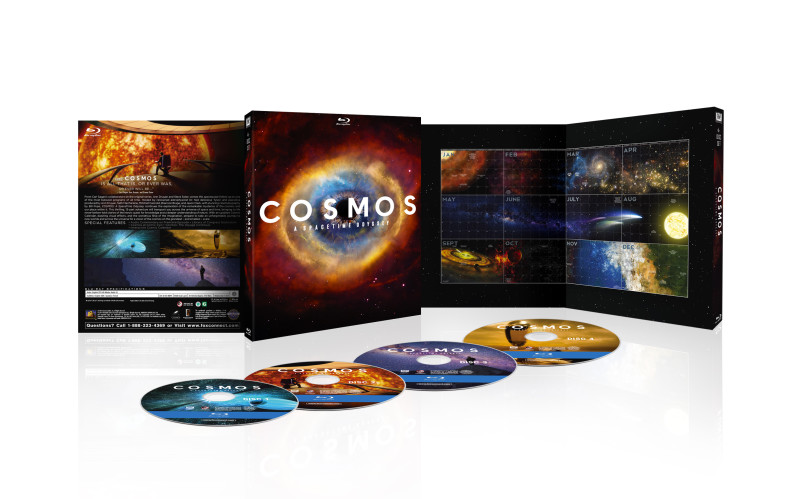
Thanks to the folks at Twentieth Century Fox Home Entertainment we’ve got a copy of the COSMOS: A SPACETIME ODYSSEY Blu-ray set to give away to one lucky NoReruns.net reader!
The widget below will step you through the various ways you can enter:
In a couple weeks, we will randomly pick the winner and contact him or her for their mailing info to forward on to the folks at Twentieth Century Fox Home Entertainment, who will mail out the Blu-ray directly. The Blu-ray can only be shipped to an addresses within the United States and Canada, and cannot be shipped to P.O. Boxes.